Freelance developer vs agency: how to choose wisely
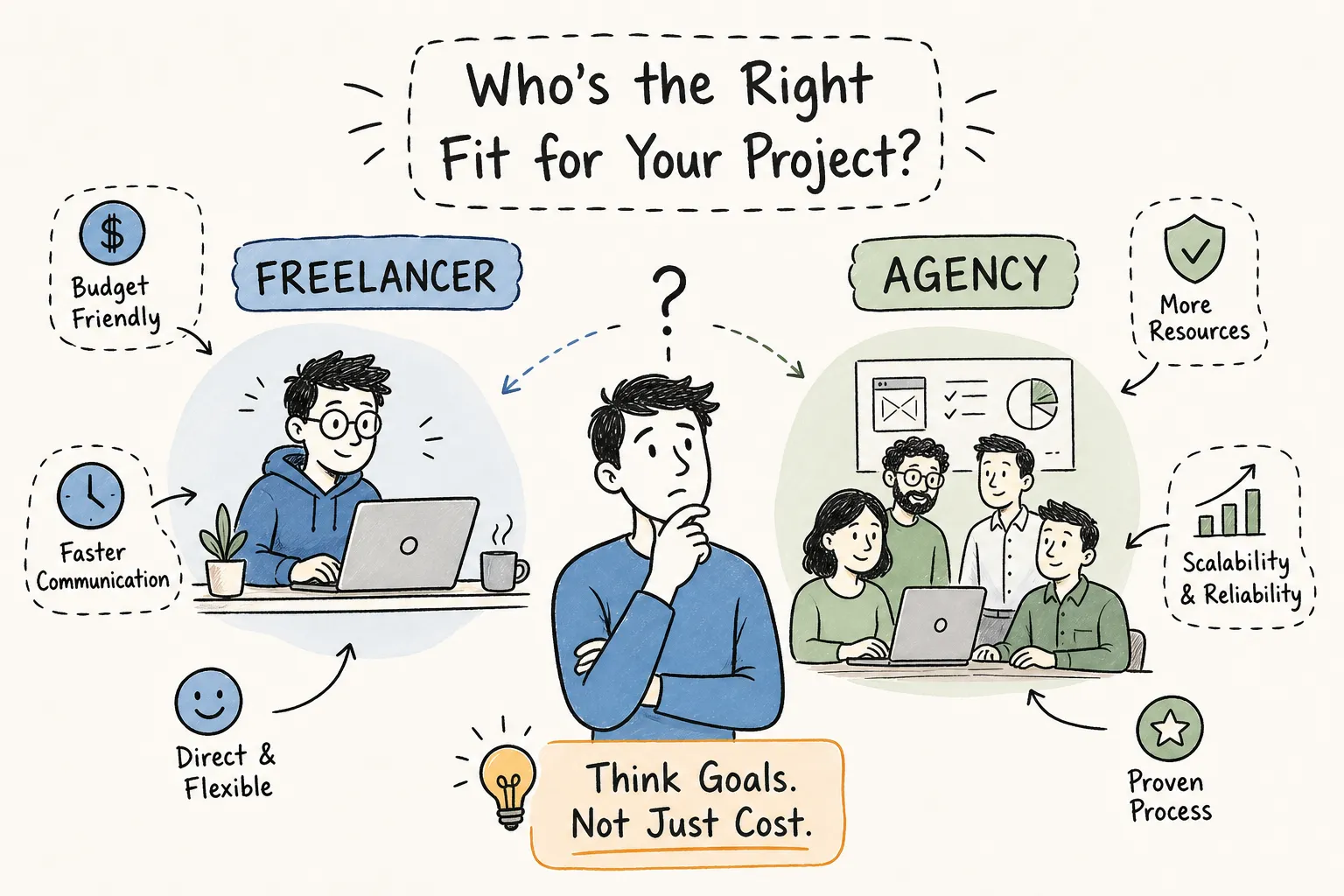
Most clients frame this as a simple cost comparison. A freelancer costs less, an agency costs more, so you pick based on budget. That framing collapses the moment something breaks at 11 PM the night before a product demo. When weighing a freelance developer vs agency, the real question is not "who is cheaper?" It is: what does your project actually require, and who will still be reachable when things go sideways?
TL;DR Summary Freelancers cost less upfront and ship well scoped Minimum Viable Products quickly, while agencies provide team backup and legal protection for complex compliance projects. For mid complexity software, AI tools, or cloud builds, hiring a senior independent consultant gives you elite engineering expertise without agency overhead or freelancer risk.
The tension is real. Freelancers offer speed, direct communication, and lower invoices. Agencies offer structure, accountability, and a team that does not disappear. Neither is always right. The decision depends on your project's complexity, your compliance requirements, and how much technical oversight you have in-house. Having consulted on both sides of this equation, as a senior full-stack engineer who has worked with startups and enterprises across Bangladesh, the USA, and Europe, I have found that the patterns separating successful hires from expensive mistakes are remarkably consistent.
This article gives you concrete numbers, real scenarios, and a clear framework so you can make the call with confidence, including the option most clients never consider.
Freelance developer vs agency, the real cost gap
Surface-level rate comparisons rarely tell the full story. A senior Bangladeshi freelancer charges somewhere between $30 and $40 per hour for web and product work (based on 2026 market data). Agencies in the same market charge $50 to $99 per hour for comparable scope, with full SaaS builds running between $30,000 and $150,000. Internationally, senior full-stack developers bill at $95 to $160 per hour, and AI/ML specialists command $100 to $250 per hour, which changes MVP budgets considerably.
For a complex web application with a senior Bangladeshi freelancer, you are typically looking at $3,000 to $10,000. An agency building the same scope charges $10,000 to $50,000 for an MVP. You are also paying for the project manager, the QA layer, and the office overhead, even when your project does not require all of it. Agencies use both fixed-price and time-and-materials contracts depending on how well the requirements are defined before work begins.
The figure that does not appear on any rate card is the rescue-job cost. A healthcare patient portal built by a freelancer for €32,000 failed a HIPAA compliance review three months in. The total cost ballooned to €90,000 once an agency was brought in to rebuild it, 180% of what the agency would have charged initially. The real cost is not the invoice; it is the cost of a failed delivery plus a full redo. Agencies carry slower feedback cycles and longer onboarding periods, which add time, particularly on smaller projects where process overhead is disproportionate to the work involved. Freelancers carry the risk of mid-project abandonment or hidden capability gaps. Both sides have genuine costs that do not appear in the initial quote. Understanding the freelance developer cost vs agency means accounting for these hidden risks, not just the headline rate.
Freelance developer vs agency: communication and accountability
When you hire an agency, you are buying the brand. The account manager takes your brief, passes it to a project manager, who passes it to a developer. Each handoff loses detail. Feedback cycles slow down because decisions require internal sign-off before they reach the person writing the code. In practice, a common complaint from mid-budget clients is that agencies reserve senior talent for enterprise accounts paying significantly more, assigning junior developers to everyone else.
A freelancer gives you one person: the individual who reads your messages, makes architectural decisions, and writes every line of production code. Delivery speed is highest when scope is tight and communication is one-to-one. A well-scoped pre-seed MVP can launch in as little as four to eight weeks with a senior freelancer; the same build through an agency can run to three months or more, depending on process overhead, backlog, and parallel client commitments, particularly at agencies with heavy internal review cycles.
The accountability gap, however, is real. Agencies carry formal contracts with indemnification clauses, warranty periods of 30 to 90 days post-launch, and service level agreements that specify response times for critical bugs. Freelancers typically operate on simpler agreements where post-launch support is either ad hoc or billed separately without formal SLAs. This gap is closeable. Senior freelancers with documented international track records and repeat clients operate with a different level of professional accountability than the generalist market. Reputation is their only leverage, and that tends to sharpen their commitment considerably.
Real scenarios where each option wins or fails
Abstract comparisons do not move the needle. Concrete scenarios do. A bootstrap SaaS MVP built by a single senior freelancer for €24,000 raised €800,000 in seed funding within nine weeks of launch. The variables that made it work: well-defined scope, a founder with strong product management experience, and no regulatory compliance requirements. At that budget, an agency would have assigned junior developers. The freelancer delivered senior expertise directly.
AI integration is a different case. When you need OpenAI API features, predictive model design, or computer vision built into an existing product, you need someone who understands both the API layer and the underlying product architecture. A generalist agency team working in separate front-end, back-end, and AI silos often produces integration that is technically correct but architecturally fragile. In many mid-budget cases, a senior full-stack engineer with genuine AI experience outperforms a generalist agency team for this type of work. The depth required does not split neatly across a rotating team.
For compliance-heavy builds, the calculation reverses. The healthcare patient portal case is instructive precisely because the failure was predictable: the freelancer lacked documented HIPAA expertise, and no one verified that before signing. Fintech platforms, healthcare SaaS applications, and products touching GDPR or financial regulations belong in agency territory unless you can verify specific compliance experience with references and documented case studies. The agency's QA layer, dedicated compliance specialists, and formal warranty structure provide measurable protection that a single developer cannot replicate.
What to look for when choosing a development partner
Underpaying inexperienced developers significantly increases the risk of costly rework, the gap between a $25/hr generalist and a $40/hr senior is often the difference between a product that ships and one that requires rebuilding. Genuine full-stack capability means more than knowing React and a back-end framework. It means understanding cloud infrastructure, database design, API security, and performance optimisation across the entire system. Check specifically for cloud experience on AWS or Azure, containerisation with Docker, and CI/CD pipeline work. Gaps in these areas create expensive handoff problems after the build phase ends.
Questions to ask during vetting
During vetting, ask the developer to walk you through a production system they architected from scratch. This question reveals far more than "what frameworks do you use?" Also ask specifically how they handle scope changes, missed deadlines, and post-launch bugs. Their answer tells you more than any portfolio item. Request references from clients with similar project types, not just website testimonials that every developer curates carefully.
Red flags worth taking seriously
- Reluctance to sign a basic NDA or agree to milestone-based payment
- No documented plan for post-launch support
- A portfolio of demo projects with no production deployments, serving no real users under real load
- Inability to explain architectural decisions in plain language, which usually signals junior depth hiding behind technical vocabulary
For an expanded checklist of warning signs and practical hiring advice when working with independent developers, see this red flags guide.
The middle ground most clients never consider
There is a third option that rarely surfaces in the freelancer vs agency conversation: a senior independent consultant who operates with agency-level professionalism but without the agency cost structure. It is a specific professional profile worth knowing how to identify, and it fits a wide range of mid-complexity projects that fall awkwardly between the two conventional options.
A full-stack engineer who also covers AI integration and cloud FinOps delivers what most agencies charge three separate specialists to provide. SaaS MVPs, AI-powered CRM systems, cloud cost audits, and multi-tenant product builds sit squarely in this zone. The work is complex enough to require genuine expertise but not so large that it requires a ten-person team. You pay for the skill, not the overhead of an entire agency's organisational structure.
One practitioner who fits this profile closely is Ahasanul Arafath, a Bangladesh-based senior full-stack engineer and IT consultant. His work covers two broad areas: full-stack development using Django, Next.js, and React; and AI and machine learning integration, including OpenAI API features, computer vision, and predictive models, alongside cloud FinOps on AWS and Azure covering cost optimisation, security auditing, and infrastructure management. International clients from the USA, UK, and the EU engage with him specifically because this combination eliminates the coordination overhead of managing multiple specialists, while maintaining the transparency and personal accountability that agencies rarely offer at comparable price points. For startups building their first SaaS product or enterprises integrating AI features without rebuilding their entire team, this model removes the most common failure points of both the freelancer and agency paths.
Making the call for your specific project
When weighing the pros and cons of a freelancer vs agency, the honest answer is that the right choice depends on three factors: your project's compliance requirements, your total budget, and how much technical project management experience you have in-house. Simple, well-scoped builds with tight budgets and no regulatory requirements belong with a vetted senior freelancer. Regulated, enterprise-scale products with complex edge cases, dedicated QA needs, and formal SLA requirements belong with an agency.
In practice: avoid junior freelancers for product builds entirely, they lack the architectural judgement required for the last 20% of complexity where most projects fail. Use agencies for compliance-heavy or genuinely large-scale builds where the formal accountability structure justifies the cost. For everything in between, the senior independent consultant model offers specialist expertise and professional accountability without the overhead of an agency billing structure.
Ultimately, choosing between a freelance developer vs agency comes down to your compliance obligations, your budget, and the technical oversight available to you in-house. If your project involves AI integration, full-stack SaaS development, or cloud infrastructure, the most useful first step is a technical consultation before you sign anything. Understanding the architectural requirements before committing to a development partner saves time and budget, regardless of which path you ultimately choose. Ahasanul Arafath offers free consultations for exactly this purpose, a clear-eyed assessment of your project's scope, compliance needs, and technical complexity will point you directly to the right kind of partner.