How to Hire a Remote Fullstack Developer the Right Way
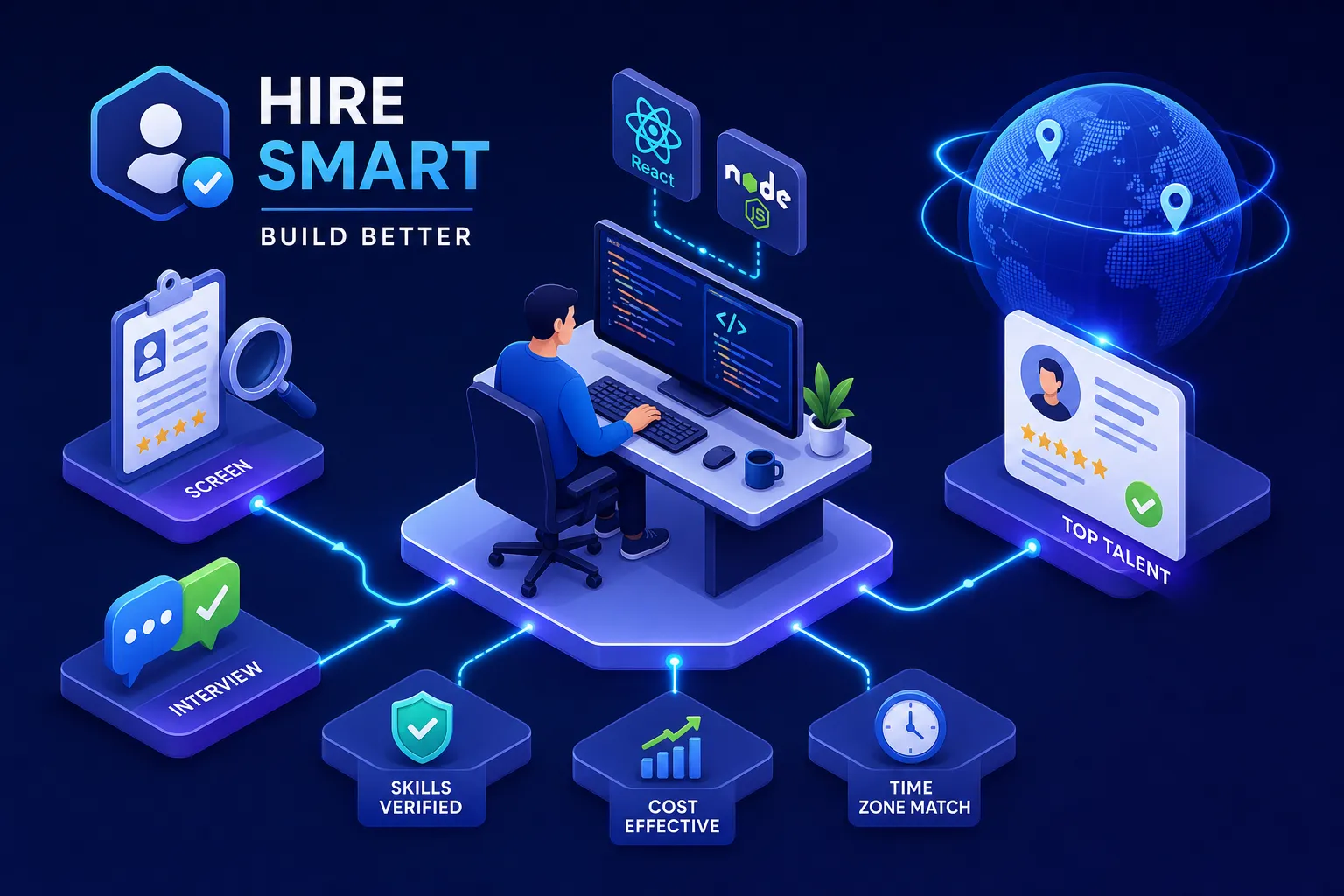
Most businesses that make a poor hiring decision when bringing on a remote fullstack developer do not fail at the technical part. They fail before the first line of code is written, because they moved fast on an impressive CV and skipped the part where you test whether someone can actually own a problem from end to end. In practice, the pattern tends to look the same: a polished portfolio, a smooth first call, and then the timeline slips and the communication dries up.
TL;DR Summary Hiring a remote fullstack developer successfully requires moving beyond a polished resume to test actual architectural thinking and async communication habits. You should focus your search on specialized developer platforms, assess how candidates handle complex technical challenges in past work, and secure a clear international contract before starting your software project.
Senior-level engineers who would have been invisible to international clients five years ago are now accessible, well-reviewed, and actively working with startups in the UK, USA, and EU. The talent pool has matured considerably. Professionals like Ahasanul Arafath, a Bangladesh-based fullstack engineer with documented international client work across AI-powered SaaS, CRM, and cloud infrastructure, represent exactly the kind of senior capability this guide is designed to help you identify and confidently hire.
This article covers five things that separate a successful remote hiring decision from an expensive one: where to look, how to evaluate technical depth, what communication fit actually means, how to read a portfolio properly, and what a fair contract looks like in 2026.
Where to find a remote fullstack developer worth your time
Not all job boards surface the same quality of candidate. Platforms like Arc.dev and Toptal are built specifically for senior remote fullstack engineer roles, with structured vetting processes that filter for demonstrable technical depth. Wellfound (formerly AngelList Talent) is a strong option for startup-focused talent, though it operates more as a curated marketplace than a pre-vetted pool, worth exploring, but with your own screening still firmly in place. We Work Remotely and LinkedIn work well once you know the exact stack you are hiring for and can filter aggressively. Generic boards flood your inbox with volume, not signal. Start with developer-focused platforms and move broader only if the niche channels come up short. Other specialist boards such as RemoteOK, Stack Overflow Jobs, and Remote.co are also worth checking, particularly if your stack requirements are specific.
Direct engagement often outperforms platform discovery. A developer who maintains public repositories on GitHub, contributes to open-source projects, or publishes technical writing is demonstrating genuine investment in their craft, not just availability for hire. That distinction matters far more than the platform you found them on. Referrals from trusted networks carry even higher signal, because someone credible has already done a layer of vetting on your behalf. When searching specifically for a remote full-stack developer in Bangladesh, local networks and communities such as LinkedIn Bangladesh and developer Slack groups can surface strong candidates who are not actively posting on international boards. If you prefer marketplaces that specialise in remote senior roles, consider platforms like Turing which focus on longer-term remote placements for experienced engineers.
Evaluating the technical depth of a remote fullstack developer
Most remote fullstack engineer roles in 2026 require genuine fluency across a minimum viable stack: React or Next.js on the front end, a solid back-end language such as Django, Node.js, or similar, PostgreSQL or equivalent relational database experience, and working knowledge of Docker and cloud platforms like AWS or Azure. A developer who lists fifteen frameworks but cannot explain their architectural choices in plain English has surface-level knowledge, not depth. The list of tools matters far less than the thinking behind why those tools were chosen.
How to assess architectural thinking in an interview
The most revealing technical question you can ask is not a coding puzzle. Ask this instead: "Tell me about a technical decision you made on a past project that you would make differently now." A developer with genuine senior-level thinking will answer without prompting, explain the trade-off clearly, and reflect on what constraint they underestimated. Coding assessments are a valuable and frequently-used filter for confirming baseline competence, particularly for code quality and error handling, and they work best when combined with scenario-based questions that assess architectural judgement and system thinking rather than acting as a standalone gate.
Push further with scenario-based questions. Ask how they would handle duplicated business logic that has fallen out of sync between the front end and back end, or how they would approach a performance bottleneck where one solution adds technical debt and another takes two full sprints to fix. The answers reveal whether they think architecturally or just tactically, and that distinction is precisely what you are paying a senior rate for. When writing role expectations or a test task, a clear full-stack developer job description can help you align assessment criteria with real-world responsibilities rather than abstract algorithm puzzles.
Communication, time zones, and the realities of async work
Time zone fit is not simply about overlap hours. It is about whether your candidate can operate productively in an async environment during the hours they are offline to your team. A Bangladesh-based developer operates on UTC+6, which provides genuine overlap with UK mornings and US evenings. That is workable for most international teams, provided both sides have agreed communication rhythms before the engagement begins. Do not hire someone expecting synchronous availability if your actual workflow is async-first.
English fluency matters, but the real signal is documentation habit. Does this developer write clear commit messages? Do their project handoffs make sense to someone who was not in the room? Can they explain a technical constraint to a non-technical stakeholder without defaulting to jargon? These are the communication skills that determine whether a remote engagement runs smoothly or degrades into repeated clarification loops. Ask for a sample of written communication from a past client, or a Loom walkthrough of a previous project, before you proceed to a technical stage.
Reading a portfolio like a senior engineer would
A portfolio is not just proof of past work. It is a window into how a developer thinks about scope, design decisions, and trade-offs. Move past the aesthetics. Understand the problem the project was solving, the constraints they worked within, and what they deliberately chose not to build. A well-articulated case study for a modest project tells you more than a flashy demo with no context around it.
Ask the candidate to walk you through one project from brief to deployment, and listen carefully for how they handle the parts that did not go to plan. A senior developer will naturally explain trade-offs, mention what they scaled and what they kept deliberately simple, and show awareness of future maintainability. Someone still operating at a junior level will describe what the project does, not why it was built that way. That distinction in thinking is what separates a developer who can own a system from one who can only execute instructions within it.
Pay ranges, contract structure, and making a realistic offer
Pay varies based on experience level and engagement model. Bangladesh-based senior fullstack developers working on international contracts typically command USD 1,500 to USD 4,000 per month on retainer, or USD 25 to USD 60 per hour for project work, depending on specialisation and track record (figures based on current market data from platforms including Arc.dev and comparable international job listings, as of mid-2026; actual rates vary and local BDT-denominated engagements may differ). That range reflects senior-level capability at rates below equivalent talent in the UK or US, senior capability, not a trade-off on quality. Developers with documented international client history and specialisations in remote software engineer full-stack roles across AI-powered SaaS and cloud infrastructure, such as Ahasanul Arafath, sit firmly within that bracket and offer an engagement model that eliminates the overhead of coordinating multiple specialists.
What a well-structured remote contract should cover
A well-structured remote contract should define at minimum: the scope of work and what is explicitly excluded, payment terms and the currency of settlement, intellectual property ownership post-delivery, and the communication expectations and revision process. For ongoing retainers, include a notice period for both parties and a quarterly review clause. Fixed-price contracts work for clearly scoped projects; monthly retainers suit ongoing development or maintenance relationships where scope evolves. Cross-border engagements should also address governing law and jurisdiction, confidentiality and data protection obligations, termination and liability clauses, and tax responsibilities on both sides, independent contractor status should be stated explicitly, as it affects tax treatment for both parties.
Get the contract reviewed by someone familiar with cross-border freelance engagements before signing. Disputes over IP ownership and scope creep are among the most common failure points in international developer relationships, and both are entirely preventable with clear language upfront. For benchmarking market compensation and role expectations from salary databases, consult aggregated sources such as Payscale's compensation data to inform your offer ranges and negotiations.
A hiring decision worth making carefully
Hiring a remote fullstack developer well is not complicated, but it does require deliberate attention to the details most hiring guides skip: architectural judgement, async communication habits, portfolio context, and a contract that protects both parties. None of these steps are difficult. They just require more intention than scrolling a job board and scheduling the first available call.
Senior-level engineers operating remotely from Bangladesh carry battle-tested experience, international client histories, and the capacity to own a technical problem from architecture to deployment. Platforms and hiring data increasingly reflect the depth of remote fullstack developer candidates available from this region, and the threshold question is no longer where your developer is based. It is whether they can think clearly about systems, communicate without prompting, and deliver without hand-holding.
Use this guide as your baseline filter when evaluating candidates for your next build. If you want to work directly with a senior engineer who has delivered across multiple industries and international clients, Ahasanul Arafath is available for an initial consultation to discuss your project requirements. Starting the conversation costs nothing and often clarifies more than weeks of job board searching.