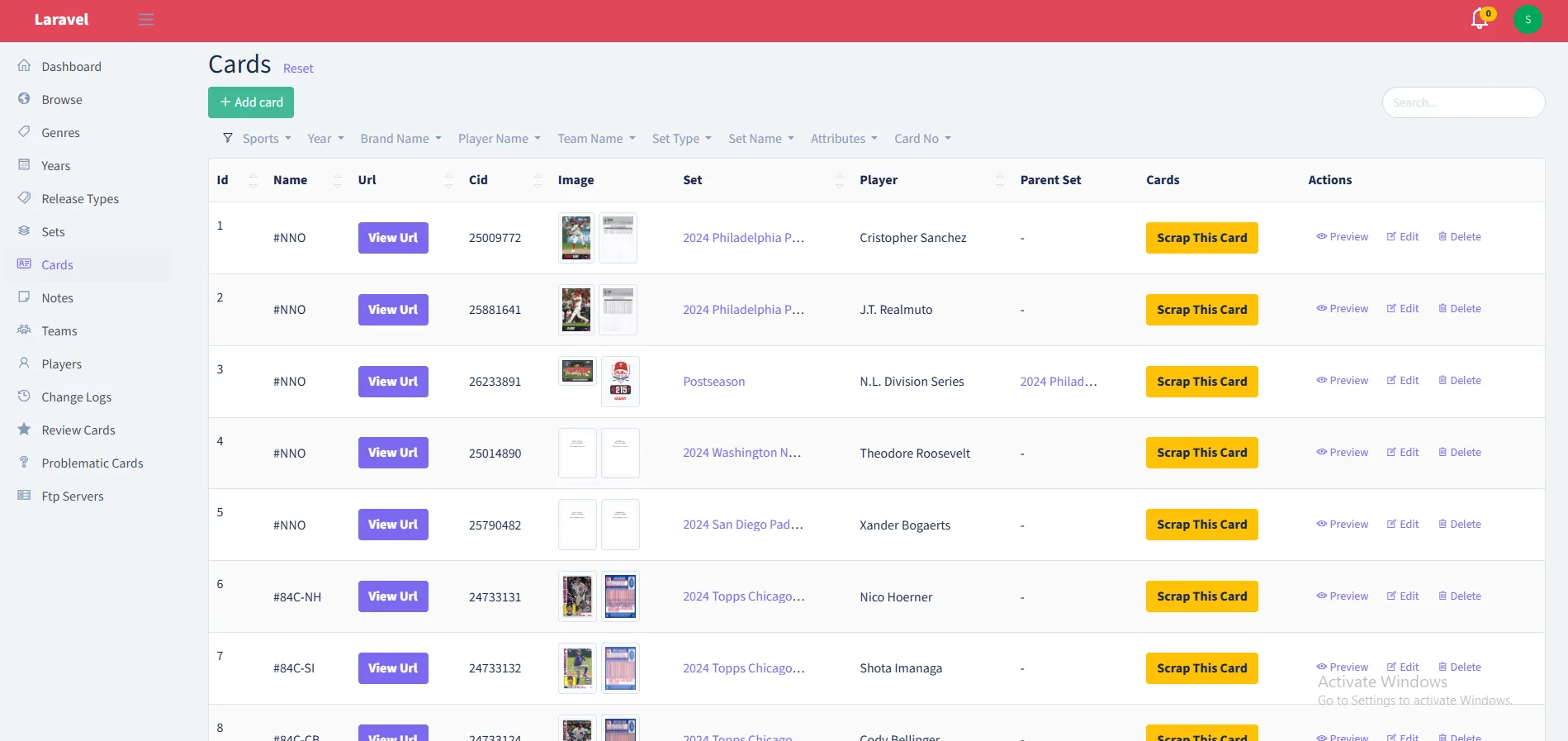
Executive Overview
Managing dynamic collectible inventories at multi-million scale introduces extreme database engineering challenges. When dealing with over 24 million individual trading card items—each undergoing real-time market price fluctuation, grading classification, and multi-channel marketplace distribution—conventional relational database architectures fail under lock contention and search bottlenecks.
Trading Card Manager solves high-volume e-commerce throughput by pairing a 3-node Galera Multi-Master MySQL replication cluster with ultra-fast Typesense in-memory indexing. This hybrid architecture guarantees ACID-compliant transactional consistency for inventory allocation while delivering sub-millisecond fuzzy search performance across tens of millions of records.
High-Throughput Scraping & Processing Architecture
To keep pace with volatile global resale markets (eBay and specialized auctions), the backend relies on a distributed high-speed ingestion architecture:
- Asynchronous Scraper Engine (Flask & Celery): Orchestrates thousands of worker tasks to continuously collect pricing trends, auctions, and historical valuation metadata across external marketplaces.
- Hybrid Microservices Ecosystem: Integrates lightweight Python (Flask/Celery) processing workers with solid enterprise web frameworks to separate background ETL (Extract, Transform, Load) pipelines from interactive frontend dashboard routing.
- Containerized Infrastructure (Docker): The entire ecosystem—spanning application microservices, ProxySQL nodes, Galera clusters, and Typesense indexing servers—is orchestrated within Docker containers for zero-downtime scalability and plug-and-play DevOps portability.
Strategic Value & Operational ROI
Beyond database performance, the system automates end-to-end e-commerce logistics. It matches newly ingested warehouse card batches against historical valuation indexes, formats listing specifications, and auto-exports synchronized CSV feeds directly to eBay. Internal operations tools automate employee grading accuracy tracking and performance calculation, transforming a complex manual cataloging operation into an enterprise automated data factory.
Key Architectural Capabilities
Scraper Engine :
Ingests massive card datasets in real-time via Flask & Celery.
Instant Search :
Real-time, fuzzy search over 24M+ synced records via Typesense.
Listing Workflow :
Automates card matching, approval, and CSV export for eBay.
Employee Ops :
Tracks processing accuracy and automatically calculates performance bonuses.
The Engineering Approach
Designed the high-speed scraping engine and inter-service communication protocols.
Implemented the ACID-compliant internal tool for card processing and inventory management.
Managed the seamless synchronization between MySQL primary storage and Typesense indices.